

CG Policy · 2025
In this section7 topics
Corporate Governance Policy
Has a Corporate Governance Policy
Yes
Policy Description
The Company operates in the real estate development sector with a commitment to creating sustainable value. We prioritise the development of quality projects that respond to market demands and generate stable, continuous, and sustainable returns for our shareholders and all stakeholder groups. The Board of Directors recognises the importance of balancing business growth with environmental stewardship and the creation of value for society. Accordingly, the Company has established good corporate governance principles and sustainable development as fundamental pillars in determining organisational direction, strategy, and management. These principles are systematically integrated into all dimensions of business operations, from planning and execution to monitoring, evaluation, and transparent, verifiable disclosure. This approach enables the organisation to achieve quality growth with operational efficiency, underpinned by a robust corporate governance framework that builds enduring confidence among all stakeholder groups.
The board of directors has established corporate governance principles, code of ethics, policies, and related practices in accordance with the Corporate Governance Code for Listed Companies 2017 (CG Code) of the Securities and Exchange Commission, Thailand. The Company's corporate governance principles align with its vision, mission, and business ethics, as detailed in the ‘Corporate Governance and Code of Ethics Handbook’. The board of directors deems it appropriate to review these policies, codes of ethics, and practices annually to ensure alignment with international standards and current circumstances. Most recently, these were reviewed and approved by the board of directors at meeting no. 9/2025 on 16 December 2025. The updated policies have been communicated to all directors, executives, and employees; they are published on the Company's intranet system as well as its website https://investor.sansiri.com/storage/document/policy/corporate-governance-code-of-ethics-handbook-en.pdf. All directors, executives, and employees of the Company are required to study the Corporate Governance and Code of Ethics Handbook. In 2025, the Company monitored compliance, fostered its integration into corporate culture, and regularly evaluated adherence to corporate governance policies. The Company also conducted annual online training (e-learning) on ‘Demonstrating Good Governance’, covering key aspects of good corporate governance, business ethics, anti-corruption policies, risk management, personal data protection, and incident management, followed by knowledge assessment tests. All directors, executives, and employees participated in and completed the training, achieving a 100% completion rate.
Policy Document Link
https://investor.sansiri.com/storage/document/policy/corporate-governance-code-of-ethics-handbook-en.pdf
Page Number in Report
1-34
Policy & Practices — Board of Directors
Has Policy & Guidelines for the Board
Yes
Board Guidelines
| Guideline | Other — Please Specify | Detail | Document Link | ||||||||||||||||
|---|---|---|---|---|---|---|---|---|---|---|---|---|---|---|---|---|---|---|---|
| Nomination of Directors | The board of directors, as representatives of shareholders, has a crucial role as organisational leaders responsible for managing operations to achieve optimal benefits for shareholders while creating sustainable value for the business. The board of directors carries out its mission and responsibilities in accordance with legal frameworks, corporate objectives, articles of association of the Company, and relevant rules, as well as shareholders' meeting resolutions and board resolutions. Furthermore, the board of directors plays a vital role in considering and approving organisational policies, strategies, vision, management direction, financial targets, and budgets, while monitoring, examining, and evaluating operational performance to ensure alignment with established plans. This is conducted considering shareholders' best interests under ethical standards with honesty and prudence while ensuring fair treatment of all stakeholders' interests. To ensure the efficient operation of the board of directors, the Company has established key policies and practices encompassing the board's composition and qualifications, director nomination and appointment processes, independent director selection, board diversity policy, as well as policies regarding directorship positions in listed companies and meeting quorum requirements. Additionally, the Company emphasizes board independence, director and executive compensation determination, director development, and performance evaluation of director duties, along with supervision of subsidiaries and associated companies to ensure operational alignment with the Company's policies and objectives. Director Nomination The Company places great importance on the nomination and selection of directors with appropriate qualifications to establish a diverse, knowledgeable, and effective Board of Directors capable of sound corporate governance. The Board of Directors has delegated to the Nomination and Compensation Committee the responsibility for determining the appropriate structure and composition of the Board, as well as conducting the nomination, selection, and recommendation of suitable candidates for directorship in cases where directors complete their terms, positions become vacant, or additional directors are to be appointed, in order to ensure that the Board composition aligns with the Company's strategic direction and business plans. The Nomination and Compensation Committee conducts director nominations in a systematic, transparent, and auditable manner, with the following key principles and considerations:
Director Nomination Process (1) Opportunity for Shareholders to Nominate Candidates: The Company recognises the importance of shareholders' rights to participate in corporate governance. Accordingly, the Company provides shareholders with the opportunity to nominate qualified individuals for consideration as director candidates at the Annual General Meeting of Shareholders in advance. The Company announces the criteria, qualifications, and nomination procedures through the Company's website and various communication channels within a specified timeframe. For the 2025 Annual General Meeting of Shareholders, the Company accepted nominations from 1 December 2024 to 31 January 2025. No shareholders submitted additional meeting agenda items or nominated candidates for director election during this period. (2) Consideration and Selection by the Nomination and Compensation Committee: The Nomination and Compensation Committee conducts a careful selection process to identify candidates possessing appropriate and complete qualifications according to established criteria, utilising the Board Skills Matrix as a supporting tool. The Committee thoroughly verifies the backgrounds and qualifications of nominated candidates, including consideration of potential conflicts of interest, directorships in other companies that may be business competitors, and the ability to dedicate sufficient time to the Company. (3) Recommendation to the Board of Directors: Following the Nomination and Compensation Committee's selection process, the Committee presents the names of selected candidates together with rationale and recommendations to the Board of Directors for careful and prudent review. Directors with conflicts of interest abstain from participation in the consideration. The Board of Directors conducts a further review of the suitability of nominated candidates before approval and submission to the shareholders' meeting. (4) Presentation to the Shareholders' Meeting: The Board of Directors presents the names of selected candidates to the shareholders' meeting for consideration and approval of director election in accordance with the criteria and procedures stipulated in the Company's Articles of Association and applicable laws. The Company ensures that the notice of shareholders' meeting contains sufficient and comprehensive information about nominated candidates to facilitate shareholders' decision-making, including: name and surname, age, educational qualifications, work history, type of directorship proposed, number of terms/years previously served as director (for incumbent directors), shareholdings in the Company and its subsidiaries, attendance record and proportion of attendance at Board and sub-committee meetings during the past year, directorships in other listed companies and non-listed entities, whether the nominee holds directorships or executive positions in businesses that compete with the Company, and relationships with the Company, major shareholders, or the Company's management, among other relevant information. The Company's Articles of Association stipulate that director election shall be conducted by majority vote of shareholders attending the meeting and entitled to vote. Each shareholder shall have one vote per share, and shareholders may vote for directors on an individual basis. Candidates receiving the highest number of votes in descending order shall be elected as directors up to the number of directors to be elected on that occasion. (5) Monitoring and Evaluation: The Nomination and Compensation Committee and the Board of Directors monitor and evaluate the effectiveness of the nomination process and Board composition annually to ensure that the Board maintains an appropriate composition, adequate diversity, and the capability to perform its duties effectively in driving the Company towards its established objectives. Results of Director Nomination for 2025 At the 2025 Annual General Meeting of Shareholders, certain directors were due to retire by rotation. The Board of Directors, excluding directors with conflicts of interest, carefully and prudently reviewed the matter in accordance with the Company's director nomination criteria and procedures, and deemed it appropriate for the shareholders' meeting to approve the re-election of directors retiring by rotation for another term. The shareholders' meeting resolved to approve the appointment of directors as proposed. The directors elected to replace those retiring by rotation possess qualifications appropriate and consistent with the Company's business strategy, as well as diversity in knowledge, capabilities, skills, experience, and expertise that are necessary and genuinely beneficial to the Company's operations.
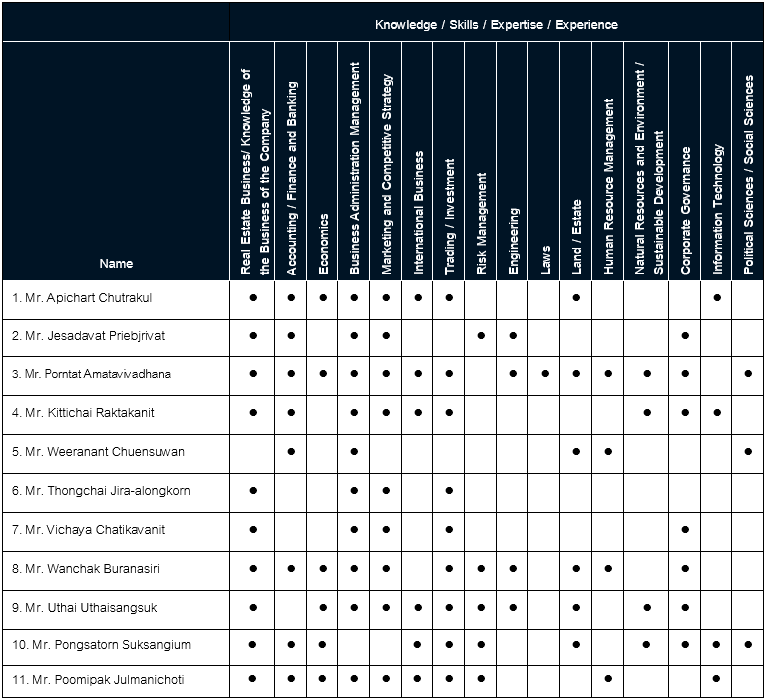
Board Skills Matrix The Company has prepared a Board Skills Matrix to demonstrate the diversity of skills, knowledge, expertise, and experience of individual directors. This serves as an important tool for analysing and planning director nominations to ensure appropriate composition aligned with the Company's business direction. The Board Skills Matrix is as follows:
Appointment and Dismissal of Directors1) The procedure for selecting directors under the Company’s Articles of Association deviates from what is outlined in Article 70, Clause 1 f the Public Companies Act of B.E. 2535 (1992), however, the Company’s Articles of Association do not deprive shareholders of the right to vote for directors. According to the Company’s Articles of Association, the board of directors must be approved by a majority vote at the shareholders’ meeting, one vote for each share. The election may be conducted for both individuals and groups, deemed appropriate by the shareholders’ meeting. Each shareholder is not allowed to distribute votes among several persons or groups. 2) At every Annual General Meeting, onethird of the directors shall vacate from the office. If the number of directors is not a multiple of three, then the number nearest to onethird shall retire from the office.The directors retiring from office during the first and second years following the registration of the Company shall be determined by drawing lots. In subsequent years, the directors in office for the longest term shall retire. A retiring director is eligible for reelection. 3) Apart from vacation upon the expiry of his/her term of office, a director shall vacate office upon (1) Death (2) Resignation (3) Lack of qualifications or subject to prohibition under the Public Limited Companies Act (4) Being removed by the resolution of the shareholder’s meeting (5) Being removed by the court order. 4) Any director wishing to resign from the office shall submit a resignation letter to the Company. The resignation shall be effective from the date the letterreaches the Company. 5) In case of a vacancy in the board of directors for reasons other than the expiration of the director’s term of office, the board of Directors shall elect a person who has the qualifications and does not possess any prohibited characteristics under the Public Limited Companies Act as a replacement of director at the next meeting of the board of directors. The replacement director shall hold office only for the remaining term of the director who replaces, unless the remaining term of office of such director is less than 2months. 6) The shareholders’meeting may pass a resolution removing any director from office before retirement, by a vote of at least three-quartersf the number of shareholders attending the meeting and having the right to vote with the number of shares at least half of the number of shares held by the shareholders attending the meeting and having the right to vote. | ||||||||||||||||||
| Determination of Director Remuneration | The board of directors appoints the Nomination and Compensation Committee to determine the policies, criteria, and procedures for nominating and determining compensation for directors, sub-committees, and high-level executives. This committee comprises 3 independent directors and 1 non-executive director, totalling 4 members, who play a vital role in ensuring appointed individuals possess appropriate qualifications and capabilities aligned with organisational requirements. The Company has established clear and transparent compensation policies for directors and board committees, considering multiple factors including benchmarking against peer companies in the real estate sector of comparable size, comparison with companies of similar revenue and market capitalization, alignment with the scope of duties and responsibilities and the Company performance, including reference to director compensation survey data from the Thai Institute of Directors (IOD). These have been considered to ensure compensation is appropriate enough to maintain and retain quality directors. The compensation determination process for directors and sub-committee members follows a structured sequence of approvals, beginning with proposals from the Nomination and Compensation Committee, followed by the board of directors review and approval, and culminating in annual shareholder approval at the general meeting. Special remuneration for non-executive directors is separately proposed by management through the board of directors for shareholder approval. This comprehensive process ensures that compensation levels and structures remain appropriate and align with all stakeholders' interests. Remuneration of the board of directors consists of meeting allowances, special remuneration for non-executive directors, salary of the audit committee member, and meeting allowances of the sub-committees. The Company has not paid any contributions to the provident funds of directors, except for Directors who are employees of the Company. | ||||||||||||||||||
| Independence of the Board of Directors from the Management | The Company recognises the critical importance of Board independence in providing effective oversight and guidance to management, thereby creating an appropriate balance between governance and management. The Company has therefore established policies to ensure that the Board of Directors can perform its duties independently from management and in the best interests of the Company, shareholders, and all stakeholder groups as follows: (1) Each director serves as a representative of all shareholders without discrimination, whether major or minority shareholders, Thai or foreign shareholders, and has a duty to safeguard the interests of all shareholder groups equally and fairly. Directors must also take into account the interests of other relevant stakeholders in order to create long-term value and sustainability for the Company. (2) The Board participates in corporate governance with independence and impartiality, free from inappropriate interference or influence from management, major shareholders, or any other parties. Each director must perform their duties, deliberate, make decisions, express opinions, provide recommendations, and cast votes on matters within the Board's authority and responsibility with independence, exercising their own independent judgement and discretion based on their knowledge, experience, and expertise. (3) All directors must perform their duties with responsibility, prudence, and integrity (Duty of Care, Duty of Loyalty, and Duty of Honesty). Directors must act in good faith for the utmost benefit of the Company and shareholders, and must not use their position or the Company's information to seek improper benefits for themselves or others. (4) Directors must not allow their personal interests or those of related persons to conflict with the interests of the Company. They must immediately disclose to the Board of Directors any conflicts of interest they have or may have in any matter related to the Company's operations, and must refrain from participating in the consideration and voting on such matters, to ensure that decisions are made independently and fairly for all parties. (5) The Company maintains a clear separation of roles and responsibilities between the Board of Directors and management. The Chairman of the Board and the Managing Director are not the same person, ensuring appropriate checks and balances. The Board of Directors is responsible for establishing policies, direction, and strategies for the Company, as well as overseeing and monitoring management's implementation of approved policies. Management is responsible for day-to-day operations in accordance with the policies, strategies, and plans approved by the Board. (6) The Board has the right to access information relevant to the Company's business operations and may request clarifications as well as professional opinions from external advisors as necessary and appropriate. Management must provide support and facilitate access to sufficient, accurate, complete, and timely information and documents to enable the Board to perform its duties effectively. The Company Secretary serves as an intermediary coordinating between the Board and management, and provides guidance to the Board regarding applicable legal requirements and regulations. The Company firmly believes that Board independence from management constitutes a fundamental pillar of good corporate governance, enabling the Board to effectively perform its duties in overseeing, monitoring, and providing guidance to management, thereby creating value and sustainability for the Company, shareholders, and all stakeholder groups in the long term. | ||||||||||||||||||
| Director Development | The Company recognises the importance of continuous development of directors' knowledge and skills, as the Board of Directors serves as a key mechanism in formulating policies, direction, and business strategies for the Company, as well as safeguarding the interests of shareholders and all stakeholder groups who have entrusted the directors with the responsibility of oversight and providing guidance to management. The Company maintains a policy of supporting directors, sub-committees, executives, and the Company Secretary in developing the knowledge, understanding, and skills necessary and relevant to the performance of their duties on an ongoing basis. This is achieved by encouraging participation in training courses, seminars, or knowledge development activities organised by relevant governmental and private sector organisations, such as the Securities and Exchange Commission, the Stock Exchange of Thailand, the Thai Institute of Directors Association, the Thai Listed Companies Association, and other specialised institutions. Additionally, the Company arranges for briefing sessions or presentations of useful information at Board meetings as appropriate, to ensure that directors and executives remain well-informed regarding laws, regulations, standards, best practices, responsibilities, and significant changes in the business and relevant environment, which will benefit the performance of their duties and the development of the Company's operations going forward. In 2025, the directors attended the courses/training as follows:
Furthermore, the Company provides orientation for newly appointed directors, all new directors must attend a mandatory orientation session. This session aims to educate them on their roles, duties, and responsibilities as directors of the Company. It will cover the Company's goals, vision, strategies, nature, and principles of business operation, as well as relevant laws and regulations. The session will also provide essential information and materials to equip new directors for efficient performance of their duties. This includes access to essential documents such as the director manual, Company profile, share capital and shareholder structure, Form 56-1 One Report, business performance data, Articles of Association, roles and responsibilities of the board and sub-committees, Corporate Governance Handbook, Code of Ethics, Anti-Corruption and Whistleblower Policy, No-Gift Policy, and other relevant Company policies. The Company secretary will serve as the coordinator for this access. Furthermore, the company did not appoint any new directors in the year 2025. | ||||||||||||||||||
| Board Performance Evaluation | The Company has delegated to the Nomination and Compensation Committee the responsibility for establishing criteria, processes, and conducting ongoing annual evaluation of the Board's performance. The primary objectives are to review and assess the effectiveness of the board's performance across various dimensions, identify strengths and opportunities for improvement in the board's operations, continuously develop and enhance corporate governance effectiveness, and determine approaches for improving evaluation criteria and processes for the following year. The Company conducts board performance evaluations at multiple levels, including evaluation of the entire board of directors, evaluation of each sub-committee, and evaluation of individual directors' performance. This comprehensive approach enables identification of specific areas for development whilst providing a holistic overview. The board of directors has established a performance evaluation process using the self-assessment method, with evaluation forms developed based on guidelines and principles from relevant regulatory bodies and professional organisations, namely the Securities and Exchange Commission, the Stock Exchange of Thailand, and the Thai Institute of Directors Association, adapted to suit the Company's business context and characteristics. The evaluation forms cover several critical areas, including board structure and qualifications, roles and responsibilities, board meetings, performance of the chairman, sub-committees, and individual directors, relationship with management, director and executive development, governance and risk management, stakeholder engagement, and disclosure and transparency, among others. Board performance evaluation is conducted at least annually, with the company secretary coordinating the evaluation process. This commences with distribution of evaluation forms to each director for self-assessment, followed by collection and analysis of results. The company secretary prepares a summary report encompassing average scores, strengths, areas for improvement, and directors' recommendations, which will be presented to the board of directors meeting. The board collectively considers the evaluation results to formulate development plans and approaches for enhancing board effectiveness in the following year. The company secretary is assigned to monitor and report progress to the board at appropriate intervals. The Company emphasises concrete utilisation of evaluation results. The Nomination and Compensation Committee utilises board performance evaluation results in several considerations, including determination of appropriate board remuneration commensurate with responsibilities and performance, consideration of appropriate board composition and structure, and identification of directors' knowledge and skill development needs. Furthermore, evaluation results serve as important input for improving work processes, defining the roles, duties and responsibilities of the Board, and ensuring corporate governance policies remain relevant and current. | ||||||||||||||||||
| Corporate Governance of Subsidiaries and Associated Companies | The Company recognises the critical importance of effective oversight of subsidiaries and associated companies, as business operations conducted through these entities directly impact the operating results, financial position, and reputation of the Group. The Board of Directors has therefore established clear policies and oversight mechanisms to safeguard the Company's investment interests and ensure that the operations of subsidiaries and associated companies align with the Company's policies and strategies, whilst adhering to good corporate governance principles. The Board of Directors oversees management's establishment of systematic frameworks and mechanisms for supervising the policies, direction, and operations of subsidiaries and associated companies. This includes appointing qualified senior executives or representatives of the Company to serve as directors of subsidiaries and associated companies, enabling close monitoring and oversight of operations. Such appointed individuals must obtain approval from the Company before voting or exercising their rights on significant matters that may materially impact the Group's business operations, such as significant asset acquisitions or disposals, connected transactions, changes to key policies, or any other actions that may substantially affect the financial statements or operations of subsidiaries and associated companies. The Company requires subsidiaries and associated companies to operate under corporate governance policies and guidelines consistent with those of the Company. The Company assigns management to monitor and oversee subsidiaries and associated companies in reporting their business plans, operational performance against established plans, and other significant matters to the Company regularly and in a timely manner. Regular joint meetings are held between executives of the Company and subsidiaries or associated companies to monitor progress, identify issues and obstacles, and ensure compliance with established policies and guidelines. Additionally, the Company oversees subsidiaries' data storage, accounting records, and financial reporting to ensure accuracy, completeness, and compliance with accounting standards and relevant regulations, enabling the Company to properly review, consolidate, and prepare consolidated financial statements within prescribed timeframes. The Company also ensures adequate and appropriate disclosure of connected transactions and transactions with potential conflicts of interest. The Company oversees the evaluations of the internal control systems and risk management of subsidiaries and associated companies to ensure appropriate and adequate control systems are in place. Where deficiencies or areas requiring improvement are identified, the Company monitors the implementation of appropriate and timely corrective actions. In 2025, the Company regularly monitored and reviewed the operating performance of subsidiaries and associated companies to ensure operations were conducted in accordance with business plans and relevant regulations, that appropriate and robust internal control systems were maintained, and that accurate and complete financial information was reported to the Company for timely preparation and disclosure of consolidated financial statements. The monitoring and review conducted in 2025 identified no significant operational issues that would materially impact the Company's business. | ||||||||||||||||||
| Other guidelines regarding the board of directors | The Policy of Holding Directorship in the Listed Company and Quorum | The Board of Directors plays a role in the company's corporate governance. To ensure that directors can devote sufficient time to their duties for the best interests of the company and its shareholders as a whole, along with showing responsibility for the performance of duties as a company director, the Board of Directors has formulated the following policies:
| https://investor.sansiri.com/storage/document/policy/policy-of-holding-directorship-in-the-listed-company-and-quorum-en.pdf | ||||||||||||||||
| Other guidelines regarding the board of directors | Company Secretary | The board of directors appointed Mr. Nopporn Boonthanom as Company Secretary, effective on 13 August 2008 with the principal duty and scope of responsibility as specified by The Securities and Exchange Act. The Company secretary takes responsibility for providing advice to the board of directors and management regarding the applicable laws and regulations they must recognise and act upon, as well as arranging the Board of directors meeting, sub-committees meeting, and shareholders’ meeting. In this regard, The Company secretary also coordinates with all involved parties to ensure that all information is properly disclosed as regulated by related organisations, that activities of the Company conform to relevant laws, objectives, and articles of association, and that the board of directors and shareholders’ resolutions as well as supervising the disclosure of information and report information in accordance with the requirements of relevant regulatory agencies. Profile and information about the Company secretary listed below: (As of 31 December 2025)
|
Code of Conduct
Has a Business Code of Conduct
Yes
Code of Conduct Description
The Company believes that ethical business management and corporate governance are the foundation for sustainable business development and growth. The Company has its written policy and is part of the Corporate Governance and Code of Ethics Handbook ('Handbook'). Some principles and practices are committed to ensuring that the directors, executives, and all employees of Sansiri Group perform their duties and operate the business properly, fairly, and responsibly towards society and the environment which will lead to long-term business value creation together with building a good relationship with stakeholders in the dimensions of the economy, society, and environment. By requiring the directors, executives and all employees to attend online learning on the topic of 'Demonstrating Good Governance', which covers important content regarding good corporate governance, business ethics, anti-corruption policy, risk management, personal data protection, and incident management, along with a test of knowledge and understanding. 100% percent of directors, executives, and employees participated in and passed this training. In 2025 there was no claim or misconduct regarding the company's ethics and code of conduct. The Handbook is available on the Company's website for all directors, executives, and employees to review and download at https://investor.sansiri.com/storage/document/policy/corporate-governance-code-of-ethics-handbook-en.pdf. Furthermore, the board of directors and executives must promote business ethics by behaving as good role models for employees, providing advice, and communicating the finest business ethics standards.
Code of Conduct Link
https://investor.sansiri.com/storage/document/policy/corporate-governance-code-of-ethics-handbook-en.pdf
Page Number in Report
11-32
Code of Conduct Practices
| Guideline | Other — Please Specify | Detail | Document Link | Page Number in Report | |||||||||
|---|---|---|---|---|---|---|---|---|---|---|---|---|---|
| Prevention of Misuse of Inside Information | Any business activities must be conducted with fairness, transparency, prudence, reliability and unquestionable integrity, including building credibility and the maximum benefits to the organisation while considering all stakeholders, not allowing personal interests to affect the performance of duties or decisions that may lead to conflict of interest or gain or loss to the Company. Managing conflict of interest is the duty and responsibility of directors, executives, and all employees which must be understood, adhered to, and acted in accordance correctly. The Company has therefore established policies and guidelines on managing conflicts of interest in Corporate Governance and Code of Ethics Handbook, Topic 6 ‘Conflict of Interest and Prevention of Insider Trading’, that all directors, executives, and employees must not engage in any business in competition with the Company or undertake any connected transaction related to themselves or persons/juristic persons, which could create any conflict of interest to the Company. The board of directors must strictly conform to the regulations and procedures for disclosing connected transactions specified by the law and the regulators. Management is responsible for taking appropriate actions to keep all employees informed and to follow such policies, as well as compiling and reporting the performance of the policies and guidelines to the board of directors for recommendations and guidelines development to improve efficiency on implementation. In this regard, the Company requires all directors, executives, and employees to disclose and confirm relationship information related to the procurement process as well as contract execution related to the projects or business and/or reports on interests and conflicts of their interests with the Company. The management will send the reminder emails in February and July of each yea rrequesting disclosure and confirmation of such relationships. All directors, executives and employees are required to fill out the report and submit supporting documents via a link provided by the Company attached to the email. The board of directors assigns human resource management to inspect and follow up on confirmation of the relationship of all directors, executives and employees. As the employees are found to have a relationship with a contractual party in a project or business of the Company, the approval process shall proceed according to the Company's regulations. Any violation, negligence, omission or intention to not comply with the confirmation of such relationship will be considered serious disciplinary action. Penalties will be considered in accordance with the Company's regulations. In the event of an unavoidable connected transaction by the directors or the executives, such transaction must follow the general business provisions, at the market price and as specified and approved by the board of directors, based on transparency and fairness in the same way as ordinary transactions undertaken with outsiders, considering the best interests of the Company. Any party involved in a conflict-of-interest transaction must not take part in considering such a transaction. If there is a connected transaction subjected to disclosure or approval from the shareholders according to the regulations of the Stock Exchange of Thailand before the transaction, the Company has a policy to disclose at least (1) names and relationships of connected persons, (2) pricing, (3) total value of the transaction, and (4) opinions of the board of directors regarding the transaction to inform the shareholders. | https://investor.sansiri.com/storage/document/policy/corporate-governance-code-of-ethics-handbook-en.pdf | 19-20 | ||||||||||
| Anti-corruption | The Company is committed to conducting business with ethical principles and responsibility towards all stakeholder groups in accordance with good corporate governance principles. We emphasise integrity, transparency, ethics, and social responsibility while considering the interests of all related parties. The Company has zero tolerance for all kinds of corruption, whether directly or indirectly, as we believe that conducting business with morality and fairness will lead the organisation toward sustainability and achievement of established goals. Anti-Corruption Policy The Company recognises the importance of implementing policies, principles, and best practices into operational processes by promoting integrity among employees and inspiring transparent performance of duties in compliance with rules and regulations. We have established appropriate and transparent financial transaction and approval systems, along with audit procedures to prevent fraud. The Company has implemented a corruption risk assessment process, established whistleblowing channels, and developed procedures for handling complaints from employees or stakeholders regarding potential misconduct while ensuring protection for whistleblowers. Furthermore, the Company pledges not to penalise or negatively affect employees who refuse to participate in corruption, even if such refusal results in lost business opportunities. The Company considers any acts, participation in, or acknowledgment of corruption as violations of the anti-corruption policy and business code of conduct. Violators will be subject to disciplinary actions as prescribed by the Company, and if such actions violate laws, legal proceedings will be considered. Detailed information about the anti-corruption policy can be found on the Company's website at https://investor.sansiri.com/en/company-overview/governance/anti-corruption and the Company’s anti-corruption policy https://investor.sansiri.com/storage/document/policy/anti-corruption-policy-en.pdf. In this regard, the Company requires management to monitor and evaluate compliance with the anti-corruption policy to identify more effective preventive measures. This includes assessing corruption risks in business processes through regular monitoring to ensure operational transparency. The Company conducts a review of anti-corruption policy compliance and performs organisation-wide corruption risk assessments at least once annually. In 2017, the Company declared its intention to participate in the Collective Action Coalition (CAC) then in 2018, the CAC passed its resolution certifying Sansiri Public Company Limited to be a member of the Thai Private Sector Collective Action Against Corruption (CAC), effective from 12 February 2018. The certification lasts for 3 years (the 1st renewal) on 30 September 2023. In 2023, the company applied for an extension of CAC certification and has passed the evaluation to renew its certification as a member of the Thail Private Sector Collective Action Against Corruption (CAC) (the 2nd renewal), which shall expire for the next certification on 30 September 2026. | https://investor.sansiri.com/en/company-overview/governance/anti-corruption | |||||||||||
| Whistleblowing and Protection of Whistleblowers | The Company has established channels for complaints and whistleblowing regarding actions that may lead to corruption. The Company will provide protection and fair treatment to all complainants, including Sansiri personnel who refuse to participate in corruption or those who report corruption related to the Company. Such channels are specified in the "Complaint, Whistleblowing, and Feedback Channels (Whistleblower Channels)". The Company will keep the information about whistleblowers confidential. This is limited to only the responsible person for investigating to have access to such information, further information can be found in the Anti-Corruption Policy, Clause 4: Protection Measures and Confidentiality for Whistleblowers and Related Parties. Whistleblower Channels:
Indicate on the envelope the recipient as one of the following: - Chairman of the Corporate Governance and Sustainability Committee (Independent Director) - Chairman of the Audit Committee (Independent Director) - Company Secretary (Office of the Company Secretary / Legal Department) Address to: Sansiri Public Company Limited 59 Soi Rim Khlong Phra Khanong, Phra Khanong Nuea, Vadhana, Bangkok 10110 Conditions and Procedure of the Whistleblower and Complainant (1) When reporting potential misconduct or unlawful activities, the details of whistleblowing or complaints must be factual, clear, and sufficient to lead to an investigation, for example, the date of the incident, where the incident occurred, details of the incident, and the source of information in order to investigate the inquiry. (2) The time required to process each complaint depends on the complexity of the case, document sufficiency, the evidence received from both the whistleblower/complainant and any cooperating parties, and the information and documentation offered by the person against whom the complaint is filed. (3) Individuals who have suffered damage will be guided through fair and comprehensive support procedures. (4) Report the complaints to the Audit Committee (independent directors). | https://investor.sansiri.com/en/company-overview/governance/anti-corruption | |||||||||||
| Preventing the Misuse of Inside Information | Prevention of Insider Information Usage and Prevention of Unfair Securities TradingIn performing duties and making any business decisions, directors, executives, and employees must act with honesty, strictly comply with relevant laws, and remain committed to maintaining the confidentiality of internal organisational information. Personal interests must not influence consideration or decision-making in assigned responsibilities. Additionally, they must not use material non-public internal information to seek personal gain or improperly benefit others. The board of directors ensures the establishment of policies for controlling the use of inside information and securities trading of the Company to ensure equality and fairness for all shareholders and to prevent directors, executives, and involved employees from trading securities for improper personal gain or others. The policy, principles, and guidelines are specified in the Corporate Governance and Code of Ethics Handbook (‘Handbook’), under section 15 ‘Prevention of Insider Information Usage and Prevention of Using Inside Information for Securities Trading’. The Company has disclosed the Handbook through its intranet system, website www.sansiri.com and provided e-learning training in the year 2025 on the Handbook on the topic 'Demonstrating Good Governance'. After the training, 100% of directors, executives, and employees took an assessment test and passed according to the criteria established by the Company. The control of inside information The Company has established an inside information control system by restricting access to non-public information to only relevant and necessary persons. Additionally, the Company prohibits all directors, executives, and employees from disclosing and/or using material inside information of the Company that has not been disclosed to the public for personal benefit or the benefit of others. All are required to strictly adhere to the Company's established policies that the Company strictly defined. Securities holding and reporting The Company’s directors, executives, and employees may invest in the Company’s securities. However, to prevent conflict of interest, directors, executives, and the employees, along with relevant department heads who may have significant inside information that would affect the Company’s share price, are prohibited to sell or buy the Company’s securities during 1 month before the release of financial statements or the announcement of inside information to the public. Moreover, the Company determines directors and executives who are obliged to report their holdings of the securities according to the definition of SEC regulations, have signed an acknowledgment to report any change to their shareholding in the Company within 3 business days from the date of purchase, sale, transfer or acceptance of transfer of securities or derivatives. They must sign from the time they first assume the position and submit it to the Company secretary within 3 business days from the date of the transaction. The Company secretary will prepare a report of changes and a summary report of the Company’s holding of securities to the board of directors’ meeting for acknowledgement, along with disclosing the changes in their holding of securities in Form 56-1 One Report. During the fiscal year 2025, from the audit, there were no complaints and/or violations by the directors and executives regarding the use of inside information or ethical misconduct. Furthermore, the Company was not subject to any fines, prosecutions, or civil actions by regulatory authorities concerning unfair practices or exploitation using inside information by the Company's directors or executives, or regarding insider trading of securities by the Company's directors or executives. | https://investor.sansiri.com/storage/document/policy/corporate-governance-code-of-ethics-handbook-en.pdf | 28-30 | ||||||||||
| Giving or receiving gifts, entertainment, or business entertainment | No Gift Policy - Gifts, Items, or Other Benefits, Including Entertainment and Hospitality The acceptance of gifts, items, or other benefits, including entertainment and hospitality, is considered normal practice in building relationships between individuals or organisations, promoting cooperation, or, on certain occasions, representing social etiquette. However, caution must be exercised as such expenses may constitute bribery if given to induce improper conduct in the performance of duties or create conflicts of interest. Accordingly, the Company requires all the Company personnel to strictly adhere to and comply with the following principles: (1) The Company personnel are prohibited from soliciting or demanding any undue benefits arising from the performance of their duties. (2) The Company personnel are prohibited from accepting gifts, items, or any other benefits from all stakeholders involved in the Company's business operations, including consenting to or knowingly allowing such actions to occur. This includes entertainment, study visits or site inspections both domestically and internationally where business partners bear the expenses, as well as any other benefits arising from the performance of duties or holding of positions. (3) The Company personnel have the duty to periodically inform business partners and relevant stakeholders of this no gift policy and to request their cooperation in implementing such measures. (4) In cases where it is necessary to accept gifts, items, or other benefits that cannot be avoided, such as when business partners are unaware of the no gift policy and have already presented items, or when personnel find themselves in situations where refusing gifts, items, or other benefits would damage interpersonal or organisational relationships, in accordance with the regulations and procedures established by the Company (5) In cases where the Company receives awards, mementos, or any items from competitions, contracts with business partners, or events of a nature that commend or recognise the achievements of the Company personnel, the Company personnel may accept such items in an organisational capacity, with managers at the Department Manager level or above designated as representatives to receive them. Such items shall be considered property of the Company. (6) The Company permits the Company personnel to accept tokens of appreciation not exceeding Baht 500 in value during traditional festive seasons, public relations events, or various seminars, such as calendars, keychains, pens, notebooks, commemorative coins bearing organisational logos or event insignia. Supervisors or managers at the Department Manager level or above shall be designated as representatives to receive and distribute such tokens to the Company personnel as appropriate. Policy on Giving Gifts, Items, or Other Benefits to Stakeholders The Company has established a policy regarding the giving of gifts, items, or other benefits to stakeholders with a value not exceeding 3,000 baht, which may be given during traditional festive seasons and customary occasions that do not violate the law, subject to approval from the level of department manager or above. Furthermore, to avoid and prevent actions that constitute bribery which may lead to corruption, the Company requires that managers at the department manager level or above verify the appropriateness before proceeding and serve as representatives to present such items or other benefits on behalf of the Company. All gift-giving activities must be approved in accordance with the regulations and procedures established by the Company. | https://investor.sansiri.com/storage/document/policy/anti-corruption-policy-en.pdf | 1, 5-6 | ||||||||||
| Compliance with laws, rules and regulations | The Company places the highest importance on strict compliance with laws, regulations, and government rules related to business operations, regarding this as a fundamental duty and responsibility that must be carried out thoroughly and continuously. The Company recognises that compliance with the law not only builds confidence amongst all stakeholders but also serves as a vital foundation for sustainable business operations and the establishment of long-term credibility. The Company is committed to promoting understanding and cooperation amongst the board of directors, executives, and employees at all levels in strictly complying with laws and the code of business conduct. This is achieved through clear communication of policies and guidelines, as well as regular training and knowledge development, to ensure that all personnel have proper understanding and can implement these practices effectively. Furthermore, the Company has established a system for regularly monitoring and verifying compliance with laws and various regulations to ensure that business operations are conducted transparently, correctly, and in accordance with relevant legal requirements. There is continuous review and improvement of practices to align with changes in laws and new regulations. In the event that any violation or non-compliance with laws or regulations is discovered, the Company will take prompt corrective action and implement preventive measures to avoid recurrence, whilst also considering appropriate and fair disciplinary action in accordance with the Company's regulations, in order to foster understanding and establish good standards for the organisation. | ||||||||||||
| Use and maintenance of data and assets | Corporate data is a valuable resource for the Company in building stakeholder confidence and a key factor in performance evaluation. To ensure that the information used in the disclosure is accurate, reliable, verifiable and internally stored in a systematic manner, the organisation expects its employees to have the discipline to record and report facts, store information, and important documents in a safe and orderly manner. The Employees shall verify the accuracy and completeness of the information every time a report or disclosure is made including maintain information security without exposing it more than necessary and ensure that such reporting does not communicate in a way that contradicts or exaggerates the facts. Do not use the inside information of the organisation for personal gain, disclose to irrelevant persons, disseminate, or facilitate the benefits of close persons. Do not modify or obscure any information of Sansiri Group that may affect the decision of the stakeholders. For data in information systems, which is operational data and various information technology of the organisation are assets of the Company that are given to employees to perform their tasks. All employees are strictly responsible for their information assets and prevention of information leaks. Employees shall always store information in an orderly manner and separate information that must be backed up to maintain organisational information such as material information, plans, or financial documents. Only employees who are authorised or have the specified rights to be able to access such files or databases. An unlicensed or unauthorised person, whether internal or external, may not have access to that information. All employees are responsible for the security of their information. The storage or destruction of data that is no longer necessary for work must comply with the Company's procedures. | https://investor.sansiri.com/storage/document/policy/corporate-governance-code-of-ethics-handbook-en.pdf | 26-28 | ||||||||||
| Anti-competitive | The Company places great importance on fair competition in the real estate industry and is committed to promoting free competition under an equal framework of rules. The Company adheres to business practices that are lawful, transparent, does not seek inside information or trade secrets through dishonest means, and does not engage in any actions that would distort market pricing mechanisms, does not collude with competitors or business partners in any actions characterised as agreements to create monopolistic power or restrict market competition, or impose trading conditions that would distort market pricing mechanisms or limit free competition, or create trade monopolies, or agreements to prevent other operators from entering the market or create barriers to free competition through unlawful, dishonest means, or means not accepted by customary practice. The Company also respects the rules, regulations, customs, and business culture of the areas where it operates. The Company respects intellectual property rights, trade secrets, and proprietary information of competitors. The Company will seek information about the market and competitors only through proper, transparent channels that are accepted under business ethics, such as public reports, trade shows, market research, or information disclosed in accordance with the law. The Company will not disseminate false or misleading information about competitors' products or services. Furthermore, the Company supports free and fair competition. The Company recognises that honest competition is a fundamental foundation for sustainable industry development and creates genuine value for consumers and society. | https://investor.sansiri.com/storage/document/policy/corporate-governance-code-of-ethics-handbook-en.pdf | 17-18 | ||||||||||
| Cyber security | Information Technology PolicyThe board of directors assigns the management to formulate an information technology policy. This initiative aims to raise awareness among executives, employees, and other stakeholders about the importance, accuracy, and security of using information technology, it will also inform participants about their duties and responsibilities as well as best practices for using technology to maximise efficiency and benefit for users, customers, and the Company. In addition, the Company is committed to ensuring to a person or an external agency that the information technology practices have been laid down in accordance with international information technology security standards, legal, and ethical principles. The latest version of the Company’s information technology policy came into effect on 15 August 2025, addresses various critical aspects, including computer centre management, authorised access to the computer centre, computer centre access control, damage prevention, substitute computer centre and backup, network management, Company’s server, computer system control, development and modification, use of the Company's email, information technology system resource management, information control and management, information technology service and support, information technology security, information technology procurement process, emergency contingency plans, and policy enforcement tracking. The policy is reviewed annually to ensure its continued relevance and effectiveness. | ||||||||||||
| Environmental management | The Company places a strong emphasis on environmental management as a fundamental component of its sustainable business operations. This includes the management of water and wastewater, hazardous waste, air pollution control, efficient resource utilisation, and the conservation of biodiversity. The Company understands that environmental impact not only affects natural resources but is also fundamentally linked to the quality of life, health, human rights, and the well-being of stakeholders in the communities surrounding its projects. The Company has developed environmental and energy policies and practices grounded in the concept of a circular economy, serving as a key framework for its initiatives, while rigorously complying with relevant environmental laws, regulations, and standards. This commitment includes the preparation of Environmental Impact Assessments (EIA) for projects that meet established requirements, aimed at preventing and mitigating environmental impacts from the initial stages of project development. Additionally, the Company is dedicated to enhancing energy efficiency, reducing greenhouse gas emissions, and promoting the adoption of environmentally friendly materials and technologies. The company also prioritises fostering environmental awareness among employees, partners, customers, and stakeholders throughout the value chain, ensuring that all sectors collaborate in advancing the organisation towards sustainable development in alignment with the United Nations Sustainable Development Goals (UNSDGs). | ||||||||||||
| Human rights | Policy and Practices on Adherence to Human RightsThe Company determines the principles and guidelines in respect of human rights to prevent human rights violations in all business activities of the Company (direct activity) including business partners in the business value chain by avoiding any action which may violate human rights and children's rights throughout the business process in all areas of operation. The Company supports the undivided concept and respects human rights. The Company realises that all human beings are equal in value and dignity: the Company has run its business concerning human dignity and openly accepts every group of employees, including LGBTQIA+. Additionally, the Company positions itself as a child-friendly organisation with awareness of not being involved in any violation of human rights, whether directly or indirectly. The Company also determines the principles and guidelines concerning human rights and children's rights in the Company’s Code of Conduct. In the operation, the Company mutually agrees with suppliers and contractors on prohibiting forced and child labour on all construction sites of the Company’s projects. The Company also practices fair treatment of all relevant parties based on dignity, and non-discrimination against origin, race, religion, gender, age, skin colour, physical condition, status, and ancestor. More details about Policy and Practices on Adherence to Human Rights can be found at https://investor.sansiri.com/storage/document/policy/human-rights-policy-en.pdf. In 2025, no human rights violations were found to be at high risk within the organisation and in the value chain of Sansiri. | https://investor.sansiri.com/storage/document/policy/human-rights-policy-en.pdf | |||||||||||
| Occupational health and safety | Occupational Health and Safety ManagementThe Company takes precedence over management, occupational health and working environment in accordance with the law and other measures in the current situation. The Company has established a policy on comprehensive safety policy covering all areas, including occupational health, and the working environment, this policy promotes a culture of safety where employees at all levels actively participate in preventing accidents and incidents involving employees, contractors, and external communities. The ultimate goal is to achieve zero accidents, with statistics on occupational accidents and illness caused as follows:
| ||||||||||||
| Other guidelines related to business code of conduct | Policy and Practices on Intellectual Property | The Company has set out principles and guidelines concerning the intellectual property of the business, organisation, and any relevant parties stated in the Code of Conduct. The Company strictly encourages its employees to understand and comply with applicable laws and regulations on intellectual property rights, including not to infringe or support any infringement of the intellectual property rights of another person. In case of any queries, consultation is available at the Legal Office for further appropriate action. In addition, the Company has a policy to use copyrighted computer programmes, which have been verified and installed by the Information Technology Department only. | |||||||||||
| Other guidelines related to business code of conduct | Supplier’s Code of Conduct | The Company has developed the Supplier’s Code of Conduct to determine the direction of sustainable business development of the Company and its suppliers and set up standards and guidelines for suppliers to study and use in working with the Company’s Group throughout their jobs. The Supplier’s Code of Conduct is disclosed on the Company website: https://investor.sansiri.com/storage/document/policy/sansiri-supplier-code-of-conduct-en.pdf The Supplier’s Code of Conduct is applied to all business partners in the Company Group's supply chain, including all suppliers and contractors. The management aims to develop operating standards in business ethics, human rights and labour standards, quality management, occupational health and safety, and the environment. To promote, support, and monitor suppliers to comply with the Supplier’s Code of Conduct, the Company is committed to collaborating with its suppliers through governance, providing information, providing appropriate operating guidelines, and assessing performance as appropriate to enable them to develop their operations under the standards set by the Company. The Company hopes that the principles of the Supplier’s Code of Conduct will drive work efficiency between the Company and all its suppliers to create trust and long-term value for all stakeholders. | https://investor.sansiri.com/storage/document/policy/sansiri-supplier-code-of-conduct-en.pdf | ||||||||||
| Other guidelines related to business code of conduct | Director’s Code of Conduct, Executive’s Code of Conduct and Employee’s Code of Conduct | Director’s Code of ConductThe board of directors plays an important role in corporate governance, formulating policies, strategies, and management guidelines for the best interests of the Sansiri Group and all stakeholders. They are responsible for the performance of their duties to the shareholders and make important Company decisions with prudence and integrity, not seeking personal benefits from holding the position of a director of the Company, preserving the inside information of the Company throughout the term of office and upon retirement, not accepting any gifts, offers, or benefits that may lead to conflicts of interest. To ensure that directors can devote sufficient time to their duties for the sufficient interests of the company and its shareholders as a whole, along with showing responsibility for the performance of duties as a Company director, the board of directors has formulated the Policy of Holding Directorship in the Listed Company and Quorum as follows:
Furthermore, during 2025, there were no cases where independent directors or non-executive directors resigned due to corporate governance issues of the Company, nor were there instances where the Audit Committee or the entire independent directors resigned. Additionally, there were no cases where Company directors committed violations related to ethical issues that contravened regulations, constituting serious offences as determined by regulatory authorities. Executive’s Code of ConductThe Company executives are the ones who drive the organisation through knowledge, capabilities, values, and vision to enable the organisation to achieve ultimate success together with all stakeholders. The Company expects executives to oversee employee performance, foster innovation, and creativity within the organisation, manage business processes with efficiency and accuracy, manage conflicts of interest, not seek personal benefits from being the executives of the Company, not bring personal interests to conflict with the interests of the Company, and not accept gifts, offers, or any other benefits that may lead to conflicts of interest, prevent and preserve internal corporate information, build confidence for all stakeholders, and look for business opportunities the vision and goals of the Company, and encourage employees to do so. Employee’s Code of ConductThe Company believes that employees are the key factor in implementing the organisation’s vision, fostering a good culture within the organisation, and preserving the interests of the Sansiri Group, and all stakeholders. The Company expects its employees to be willing to work consistently, take responsibility for their work, cooperate in promoting the Company’s activities, be responsible, disciplined in work, and perform fully assigned tasks of knowledge and ability, respect opinions and differences, promote business ethics to colleagues, and always promote the ethical culture of the organisation. |
Promoting Compliance with the Code of Conduct
Promotes Compliance by Directors, Executives and Employees
Yes
Description
The Company recognises that the code of business conduct is a fundamental foundation for sustainable business operations. The Company has therefore established a process to promote strict and continuous compliance with the code of business conduct amongst the board of directors, executives, and employees at all levels. The Company has prepared a clear and comprehensive code of business conduct policy with fair disciplinary measures to ensure that business operations are conducted with integrity, transparency, adherence to the law, responsibility towards society and the environment, and building confidence amongst stakeholders, so that the organisation can grow sustainably. The Company has set out the code of business conduct in the "Corporate Governance and Code of Ethics Handbook".
The Company places importance on communication and building understanding about the code of business conduct through orientation for new employees and annual refresher training courses. Directors and employees are required to attend online training on corporate governance and the code of business conduct annually. In 2025, online training was provided on the topic "Demonstrating Good Governance". Following the training, 100% of directors and employees completed the assessment and passed the criteria set by the Company. Information is also disseminated through internal communication channels to ensure that everyone is aware of the importance and understands the proper guidelines for conduct. In addition, the board of directors and executives play an important role in being good role models by demonstrating their commitment to complying with the code of conduct with honesty and transparency, which creates a strong organisational culture and promotes proper conduct at all levels.
The Company has established an effective system for monitoring and verifying compliance with the code of conduct. The internal audit department is responsible for auditing and reporting on compliance to the audit committee and the board of directors on a regular basis. In addition, secure and confidential channels have been established for reporting concerns or complaints (Whistleblower Channels) for those who witness conduct that is inconsistent with the Corporate Governance and Code of Ethics Handbook or policies. The Company will conduct thorough and fair investigations whilst protecting the rights of whistleblowers in accordance with the established policy. In the event that a breach of the code of conduct or the Company's policies is found, appropriate and fair disciplinary measures will be considered and implemented to ensure understanding and serve as a good standard for the organisation.
Further information on the Company's Corporate Governance and Code of Business Conduct Policy, as well as other policies, can be found at https://investor.sansiri.com/th/company-overview/governance/corporate-governance-policies
Anti-Corruption Networks & Projects
Joined or Declared Intent to Join Anti-Corruption Networks
Yes
Networks & Projects Joined
| Network / Project | CAC Certified |
|---|---|
| Thai Private Sector Collective Action Against Corruption: CAC | Y |
| United Nations Global Compact (UNGC) | |
| Participation of anti-Corruption networks and initiatives |
Material Changes & Developments in CG
Reviewed the CG Policy or Board Charter in the Past Year
Yes
Material Changes or Developments in the Past Year
Yes
Policy Review — Description
In 2025, the meeting of the board of directors no. 9/2025 on 16 December 2025 approved the revision of the essences of the Corporate Governance policy, guidelines, and monitoring system to be in line with the current circumstances, details published on the Company website (https://investor.sansiri.com/en/company-overview/governance/corporate-governance-policies), as follows:
- Corporate Governance and Business Ethics Handbook
- Anti-Corruption Policy
- Sansiri Sustainable Development Policy
- Tax Policy
- Human Rights Policy
- Environmental and Energy Conservation Policy
- Stakeholder Policy
- Biodiversity Policy
- Corporate Social Responsibilities Policy
- Enterprise-Wide Risk Management Policy
- Policy on Investor Relations Activities
- The Policy of Holding Directorship in the Listed Company and Quorum
- Green Procurement Policy
- Policy on the Promotion of Creative Ideas and Innovation Management
- Policy on Credit Terms with Trading Partners (Credit Term)
- Business Continuity Management Policy
- Digital Asset Investment Policy
- The Human Resources Management Policy
In 2025, the aforementioned company board meeting approved the following additional policies:
- Waste Management Policy
- Water Management Policy
- Sustainable Property Portfolio Management Policy
Implements the CG Code for Listed Companies
No
CG Code — Description
Regarding compliance with corporate governance principles, code of conduct, policies, and related practices in accordance with the Corporate Governance Code for Listed Companies 2017 (CG Code) of the Securities and Exchange Commission, the Board of Directors has carefully considered and recognised its leadership role within the organisation. The Board has thoroughly and carefully reviewed the CG Code principles and understands the importance and benefits of implementing these principles to create sustainable value for the Company. The Board has also assessed compliance with each principle to ensure that the CG Code 2017 has been adapted to the Company's business context.
At the Board of Directors' Meeting No. 9/2025 held on 16 December 2025, a resolution was passed to approve the review and amendment of the Company's corporate governance policy to ensure alignment with current circumstances and appropriate practices. Over the past year, the Company has continuously complied with the Corporate Governance Code (CG Code) 2017. However, for certain practices that the Company has not yet adopted, the Board of Directors has considered and studied appropriate courses of action suitable to the organisation's context, with annual reviews conducted regularly. In 2025, there are significant matters where the Company's approach differs from general practices, as follows:
Policy on Tenure of Independent Directors Not Exceeding 9 Years from First Appointment
The Board of Directors is of the view that the Company's current independent directors are capable of expressing independent opinions and dedicating sufficient time to their duties. The Nomination and Remuneration Committee has conducted a thorough nomination process, taking into consideration the appropriateness of directors' knowledge, capabilities, and experience relevant to the business, as well as their ability to dedicate sufficient time to the Company. The Committee has proposed qualified individuals to the Board of Directors for consideration of appointment and nomination of suitable persons to replace directors retiring by rotation to the shareholders' meeting as appropriate.
Election of Directors by Cumulative Voting
The Company's Articles of Association stipulate that directors shall be elected by a majority vote of shareholders attending the meeting and entitled to vote, with each shareholder having votes equal to the number of shares held. Although cumulative voting is not used, the Company has consistently given due regard to the rights of minority shareholders by allowing shareholders to propose agenda items for the Annual General Meeting in advance and to nominate persons for consideration as directors of the Company, which reflects the importance placed on treating all shareholders' rights equally.
Chairman of the Board Being an Independent Director
At present, the Chairman of the Board does not hold independent director status. However, the Board of Directors is of the view that the current Chairman possesses in-depth and continuous understanding of the Company's real estate business over an extended period and has sufficient time to dedicate his knowledge and capabilities to fulfilling his duties to the Company. Moreover, in the current economic climate and competitive environment, the skills, experience, and specialised expertise in the real estate development business are of great value and benefit to the Company's business operations. This represents a strength that will help drive the organisation towards achieving its goals and success efficiently.
Other CG Performance & Outcomes
The Company has been awarded the "ASEAN Asset Class PLCs" recognition, a regional honor under the ASEAN Corporate Governance Scorecard (ACGS) initiative, which is supported by the ASEAN Capital Markets Forum (ACMF) and the Asian Development Bank (ADB). The ACGS project evaluates corporate governance standards of more than 569 large publicly listed companies across the ASEAN region, based on information and performance in 2024. This award is granted to listed companies that achieve a corporate governance assessment score of 97.50 or above, reflecting the Company's commitment and success in elevating its corporate governance standards to a leading level in the region. Receiving this award demonstrates the Company's dedication to conducting business with transparency, accountability to stakeholders, respect for shareholders' rights, fairness, and ethical business practices in accordance with international corporate governance standards.
The Company received SET Awards 2025, namely the ‘Sustainability Excellence: Highly Commended Sustainable Supply Chain Management Awards’ (for listed companies on the Stock Exchange of Thailand with market capitalization between THB 30,000-100,000 million).
The Company has been selected as one of the sustainable stocks or SET ESG Ratings, conducted by the Stock Exchange of Thailand to assess performance in Economic (including corporate governance), Environmental, Social, and Governance (ESG). The Company achieved an ‘AAA’ rating for the sixth consecutive year of the recognition.
The Company received evaluation scores from the Corporate Governance Report of Thai Listed Companies (CGR) for the year 2025, organised by the Thai Institute of Directors (IOD) and the Stock Exchange of Thailand, in the ‘Excellent’ criteria (5-star level) for the sixth consecutive year.
The Company received the full score of 100 from the 2025 Quality Assessment of the Thai Investors Association’s Annual General Meeting (AGM) for the eighth consecutive year.